Showing posts with label 5º E. Show all posts

Sunday, May 16, 2021

Normas de la Asamblea

Las asambleas son un recurso para el aprendizaje y la práctica de la democracia. Es el espacio ideal para ver las diferencias en positivo, apreciar la inteligencia de todos o ser solidarios los unos con los otros.


En nuestro caso vamos a realizar esta actividad para reflexionar y debatir acerca de la convivencia de nuestro centro, porque queremos una escuela libre de cualquier tipo de violencia, en especial del ciberacoso o ciberbullying. Queremos una escuela como la de Alan, del Club de los Valientes, en la que todos los chicos sean valientes.


Las asambleas son un lugar en el que el alumnado y los docentes expresamos nuestras opiniones sin miedo y en un plano de igualdad. Soñamos el centro que deseamos: Un centro óptimo en el que todos nos comprometemos para conseguirlo.


La asamblea tiene una trascendencia institucional, es decir, todo lo que hablemos y consensuamos en ella llegará a todos los espacios del centro.


Las asambleas son importantes porque:

  • Aprendemos a expresar nuestra opinión y escuchamos la de los demás de modo respetuoso.
  • Escuchamos y sentimos que nos escuchan. Aumenta nuestra autoestima, nos sentimos bien.
  • Reflexionamos sobre lo que se está debatiendo.
  • Creamos nuestra opinión en construcción y teniendo en cuenta la de los demás.
  • Respetamos unas normas.
  • Valoramos y respetamos las opiniones de los demás. Es muy bonito cuando descubrimos que en nuestra escuela se está llevando a cabo algo que propuso otro compañero.
  • Nos motivamos a llevar a cabo las propuestas que mejoren la convivencia de nuestro centro.
  • Aprendemos los mecanismos de participación democrática como son: acuerdos, pactos, votaciones y consensos.
Para la realización de esta práctica seguimos unas normas que nuestro alumnado ha estado trabajando en las dos últimas semanas.

El grupo de "5º E" ha realizado un vídeo que exponemos a continuación.

Tuesday, February 9, 2021

Celebrating Safer Internet Day

 We celebrate Safer Internet Day with activities organised by INCIBE, the National Institute for Cybersecurity, which works to strengthen digital trust, increase cybersecurity and resilience, and contribute to the digital market in a way that promotes the safe use of cyberspace in Spain.


During the morning we carried out the following activities:

1. Opening session of the event.


2. Inspirational talk for children: Encouraging safe and positive digital experiences in the classroom. Important conclusions from the session:
  • ¡Use your common sense! We often perceive a website or a link to be suspicious: if you are not sure, do not access it and avoid putting your security at risk.
  • Create a good password! It's the key to your information, so it should be secret and hard to guess: use a combination of uppercase and lowercase letters, numbers and symbols.
  • Be careful on social networks! Some messages or profiles use the networks to spread scams and viruses: never download or access links sent to you by a stranger.
  • Play safely online! Messages about virtual gifts or free upgrades may carry a virus: notify the game administrators and delete the message.
  • Beware of incredible discounts! Promotions shared on the Internet can be fraudulent: check the information before trusting or spreading the message.

3. Dialogue: Cybersafe experiences from the point of view of young people.


4. Guided activities on safe use, frauds and viruses: Internet Trapbusters! With this workshop we work together on the detection and prevention of fraud and viruses on the Internet, to prevent them from infecting your devices or stealing your and your family's information. In this link we share the complete information of the workshop along with the materials.


5. Competitions through Kahoot.


Thank you INCIBE!

Friday, February 5, 2021

Hungarian Final Products - Starting Poland Good Practice

 HUNGARIAN FINAL PRODUCTS

Through a video call we connect all the classes involved in the good practices. The students presented their work about Hungarian good practice. As we have mentioned in previous posts, they have produced posters with tips on how to detect fake images on the web.


Click on the image to access all the photos of the session.


Click on the image to access all the drawings with tips (5º B)


Click on the image to access all the posters with tips (5º E)

STARTING POLAND GOOD PRACTICE

We started the good practice from Poland "Communication on the Internet". We presented the theoretical part of the topic which revolved around these two objectives:
  1. To be encouraged to use the Internet safely.
  2. Become familiar with the positive and negative aspects of Internet communication.
The contents and activities can be found in detail in the following presentation:


First activity: Without using verbal communication and simulating a WhatsApp conversation, the different classes talked about previously agreed topics. The aim was to reflect on when communication is best:

When we write or when we read.
When there is eye contact.
When we see emotions.

We use the following worksheet:


Iraide, a student in 5th grade E, reads the comments on her comments and thinks about her own message.

Generally speaking, all classes agreed that they like face-to-face communication better for the following reasons:
  • It is not good to abuse screens.
  • You know how the other person feels and you correct your own speech if you see that your partner is offended.
  • You can relate and sense whether or not the receiver agrees with what is being said. If there is a problem, a constructive discussion can be established.
  • Eye contact facilitates active listening.
  • You adapt your responses according to the feelings and emotions you see in the other person.
  • It helps our socialisation.
  • Spelling mistakes and misunderstandings are avoided.
We invite you to visit the following board where you can consult the opinions of each of the classes participating in the activity.


Hecho con Padlet
THANKS A LOT!

Wednesday, January 27, 2021

Hungarian Good Practice: First steps

 HUNGARIAN GOOD PRACTICE

JANUARY 15, 2021

Recibida la formación teórica el alumnado de 5º E comienza su trabajo consistente en una presentación con consejos a seguir para detectar imágenes falsas en Internet.

Having received the theoretical training, the students of 5th grade E begin their work consisting of a presentation with advice to follow in order to detect fake images on the Internet.

Presentación utilizada para la formación teórica y seguimiento de la buena práctica / Presentation used for theoretical training and follow-up of good practice.

Lo vamos a hacer con una presentación colaborativa de Google y como se puede ver en la siguiente imagen nos hemos organizado en parejas para abordar los consejos que queremos trabajar y transmitir a nuestros compañeros.

We are going to do it with a collaborative Google presentation and as you can see in the following image we have organised ourselves in pairs to tackle the advice we want to work on and transmit to our classmates.


Utilizaremos la herramienta postermywall y lo haremos con la cuenta de correo electrónico del proyecto. La tarea de esta sesión consiste en seleccionar la plantilla que mejor se adecúe a nuestros propósitos, sintetizar el consejo en una o dos líneas, y comenzar los primeros pasos de edición. A continuación os compartimos fotos del proceso de esta sesión. ¡Saludos!

We will use the postermywall tool and we will do it with the project's email account. The task of this session is to select the template that best suits our purposes, synthesise the advice in one or two lines, and start the first steps of editing. Here are some pictures of the process of this session. Greetings!


JANUARY 27, 2021
Los alumnos de 6º C realizan los primeros pasos de la actividad con las profesoras María Luisa Dávila e Inés Carretero.

The students of 6th grade C take the first steps of the activity with the teachers María Luisa Dávila and Inés Carretero.


Clic en la imagen para acceder a todas las fotos de la sesión / Click on the image to access all the photos of the session.

Friday, December 18, 2020

Good practices: Final products of Turkey and Romania

Nuestros alumnos de quinto presentan a través de Meet sus trabajos sobre las buenas prácticas de Turquía y Rumanía.

Our fifth graders present their work on best practices from Turkey and Romania through Meet.


Buena práctica de Turquía / Turkish Good Practice

Todo el nivel de 5º participó en un Padlet en el que tuvieron que simular conversaciones de WhatsApp que incluyeran abreviaturas. La actividad fue un éxito y el resultado lo compartimos a continuación.

The whole 5th grade participated in a Padlet in which they had to simulate WhatsApp conversations including abbreviations. The activity was a success and the result is shared below.

Hecho con Padlet

Los alumnos de 5º C realizaron una presentación colaborativa con Google donde investigaron sobre las abreviaturas que están admitidas cuando escribimos mensajes de texto. Aunque no es aconsejable realizar un uso excesivo de las mismas. Os invitamos a ver la presentación de nuestros compañeros. ¡Enhorabuena a la clase y a su teacher Daniel Gallardo!

5th grade "C" students made a collaborative presentation with Google where they researched about the abbreviations that are allowed when writing text messages. Although it is not advisable to use them excessively. Congratulations to the class and to their teacher Daniel Gallardo!


Los alumnos de 5º E hicieron una presentación colaborativa en la que reflejaron los consejos más importantes que debemos seguir cuando escribimos mensajes a través de los principales servicios de mensajería.

The 5th E pupils made a collaborative presentation in which they reflected on the most important tips to follow when writing messages through the main messaging services.


Buena práctica de Rumanía / Romanian Good Practice
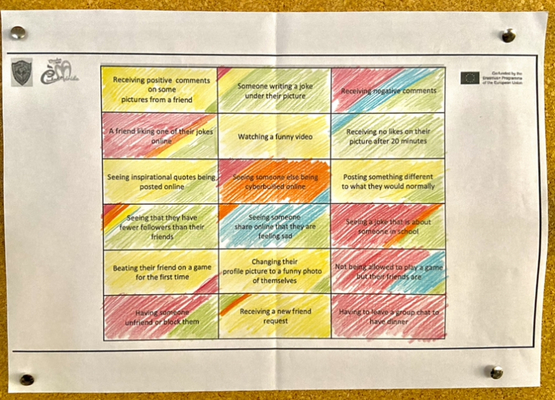
Tanto los alumnos de 5º C como 5º E optaron por llevar a cabo la actividad de resiliencia consistente en colorear las situaciones presentadas con el color que representa la emoción. Rojo: enfado; naranja: preocupado; amarillo: feliz; azul: triste; y verde: no me afecta.

Both 5th C and 5th E students chose to carry out the resilience activity consisting of colouring the situations presented with the colour that represents the emotion. Red: angry; orange: worried; yellow: happy; blue: sad; and green: does not affect me.

Aprendimos que cada uno experimenta emociones distintas a una misma situación, en otros casos coincidimos, y también se dio que una misma acción podía tener varias emociones según el estado de ánimo o las circunstancias personales de la persona. Enlace a las fichas de trabajo de 5º E.

We learned that everyone experiences different emotions in the same situation, in other cases we coincided, and we also learned that the same action could have different emotions depending on the mood or personal circumstances of the person.
Hoja de trabajo de la alumna: Lucía Mendoza Fernández / Student worksheet: Lucía Mendoza Fernández.


Hoja de trabajo de los alumnos de 5º C / 5th C students' worksheet

English post in our TwinSpace


FOTOS DE LA IMPLEMENTACIÓN DE LA BUENA PRÁCTICA DE TURQUÍA POR LOS ALUMNOS DE 6º C